Complex and Custom Corrugated Packaging: Special Structures Designed for Each Job
Complex packaging is corrugated packaging with a structure designed entirely from scratch, without relying on a standard FEFCO style, because the requirement goes beyond an ordinary box in size, load, assembly mechanism, or the test criteria it must pass. Each job starts from a brief based on real site conditions, and a prototype is made before production.

The Auto Boxes process starts with your brief and the real constraints on site. The Technical Service team designs the die-line and sets the box strength based on the product, how it is shipped, and how it is stored and stacked, then makes a prototype for you to test with the real product before production. This typically takes 14 to 21 business days.
Types of Jobs in This Group
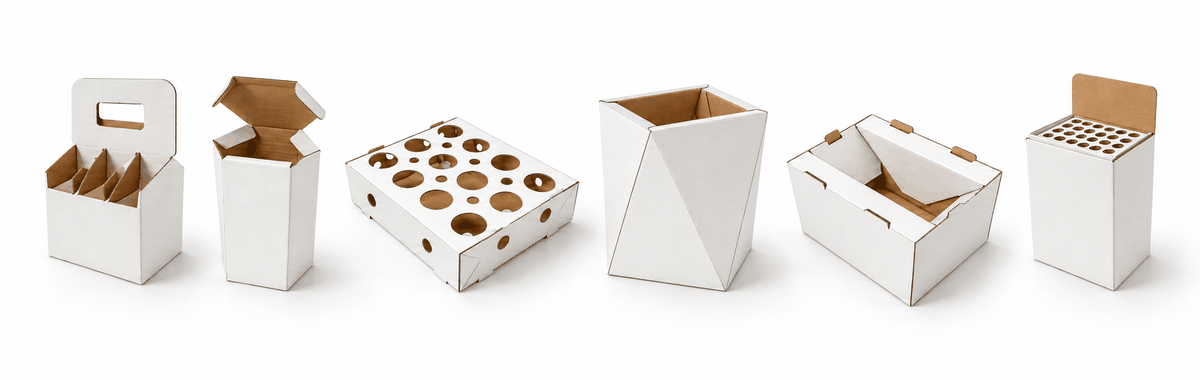
Structures and assembly methods designed from scratch for each job
Every job in this group starts from the customer brief, so our team writes a new die-line and assembly sequence to match the product, how it is shipped, and how it is stored and stacked. When those three conditions change, the shape, size and number of parts change with them. These five types of requirement come up most often.
-
1
Beyond standard size and weight
Oversize / Heavy-DutyProducts such as machine parts, motors and assembled furniture often exceed what a standard box can handle. Jobs like these usually use 5-ply BC flute board, with box strength set from the product weight together with the number of layers stacked in the warehouse.
-
2
Structures built for specific loads
Load-Bearing StructureStructures designed to spread compression along the directions the product actually carries load, for example increasing the load-bearing corners from four to six, or reinforcing the side that carries the most weight. Each job takes a different approach depending on the product and how it is stacked.
-
3
Mechanisms built into the box
Handle / Lock-inSome boxes have to work on their own, with handles that hold the weight for as long as the box is carried, built-in lock bottoms, and tabs that assemble without glue or tape. These mechanisms are designed together with the structure from the start, so no extra materials need to be added later.
-
4
Unboxing features
Unboxing DesignGift boxes, premium seasonal boxes and luxury products use the moment of opening as part of the brand. Our team designs pop-up structures, inner display tiers and a specific opening method for each design, so they work reliably in volume production.
-
5
Specified test criteria
Specified Test CriteriaSome jobs come with test criteria from the start, whether export orders with criteria in the contract or domestic jobs where the customer sets its own conditions. Our team makes those criteria part of the brief from the design stage, then makes a real sample for inspection before the cutting die is made. For dangerous goods that need UN-marked packaging, our team coordinates the testing and UN marking for your box design.
Requirements outside these five can be assessed too. The Technical Service team will ask to see the actual product or a drawing with dimensions and weight, along with how it ships and how many layers it is stacked, then designs the structure and makes a sample to test with the real product before production.
Assessing a Complex Packaging Job: What to Know Before You Start
Signs and information needed before starting
Jobs in this group are assessed on the requirement rather than the box type, because the structure is different for every job.1. Signs that a requirement calls for complex packaging
- The product is larger or heavier than a standard box can handle.
- It needs a specific mechanism, such as a built-in lock, a handle, or features that create a brand experience.
- The purchase contract specifies test criteria, or the product is classed as dangerous goods and needs UN-marked packaging.
- A requirement that has no clear solution yet, whether the challenge is shape, weight or how the box is used. The Technical Service team takes on requirements at this level and turns them into boxes that can be produced and used in practice.
- The product and its actual dimensions
- Weight per item and per box
- Shipping method: road, sea or air
- Stacking layers and storage method
- Test criteria required by the contract, or the UN number of the product, if any
- There is no fixed price for this group, because the structure differs for every job.
- From complete information to delivery takes 14 to 21 business days, including design and sampling.
💡 Internal and External Dimensions Differ by the Board Thickness
You can send us the product size, the internal size of the box, or the external size of your current box. Just note which one it is, because 5-ply corrugated board is about 4 to 8 mm thick, so internal and external dimensions are never the same. With inner parts such as dividers or trays, the space left for the product differs from the external size even more.Once we know where the numbers were measured, our team allows for board thickness, clearance for putting the product in and taking it out, and the space taken by inner parts all at once, then draws the die-line and makes a real sample for you to test with your product.
If you already use a box, the easiest way is to send the current box, or photos with measurements. Our team can see how it allows for clearance and where it causes problems in use, then build on what already works without measuring everything from scratch.